



 HOCKEY CANADA

U9 Hockey
At the U7 and U9 age levels, hockey is about learning, confidence, fun and long-term development.
Hockey Canada’s approach to small-ice hockey (cross- and half-ice) and small-area games is rooted in one simple idea:
Kids have fun and learn the game best when they are involved in the play, not watching it. And this is not only for beginners—small-ice hockey is also best for developing high-performing players.
Hockey Canada’s Development Philosophy at Young Ages
At U7 and U9, the goal is to:
- Have fun and get active
- Create a positive experience for every child
- Learn and build strong fundamental skills
- Develop hockey sense and decision-making
- Develop and refine basic motor patterns
- Practice cooperation and fair play
- Support long-term participation, not early specialization
Small-ice hockey and small-area games are age-appropriate and have proven to better support these outcomes than full-ice play at these ages.
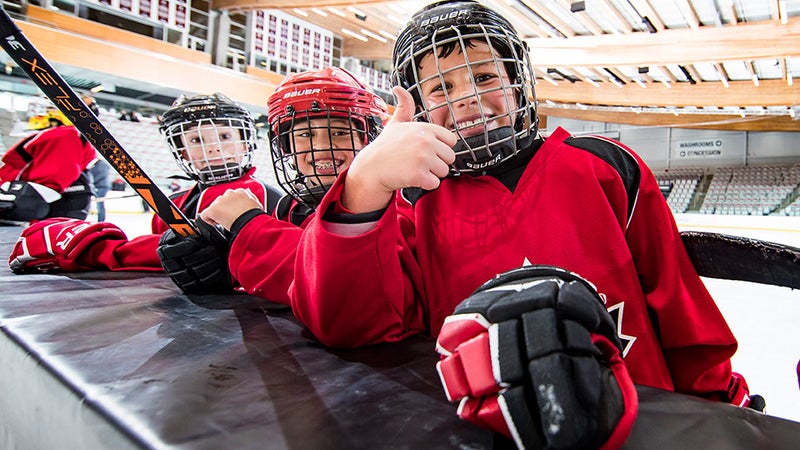
Why Small-Ice Hockey & Small-Area Games?
The benefits of playing in a reduced space with less players, instead of 5-on-5 on a full-ice playing surface include:
- Increased engagement and fun atmosphere
- Faster and improved decision-making
- More chances to develop and practice skills in real game situations
These benefits mirror what the game looks like at higher levels, where most of the play happens in smaller areas of the ice versus end-to-end rushes.
- Based on recent statistics, approximately 82% of the game is played in either the offensive or defensive zone.
- Typically, all 10 players will be “blue line in” when the puck is in one end zone or the other.
Player development happens every day at practice not just on game day. Hockey Canada emphasizes practice environments that maximize learning, repetition and engagement through small-area games and station-based training.
This approach supports development at young ages by providing:
- More meaningful repetitions in every practice
- Consistent opportunities to apply skills in realistic situations
- Higher activity levels with less standing and waiting
- More chances to make decisions and solve problems
- Better use of practice time to develop fundamentals
- Stronger habits through repetition and feedback
- A learning-focused environment rather than a results-focused one
By designing practices that utilize stations and smaller spaces that are active, game-like and skill-centered, coaches and volunteers help ensure players are developing the right habits, building confidence, and getting the most value from every minute on the ice.
The Biggest Benefits for Players
1. Every player is more involved
Compared to full-ice hockey, cross- and half-ice play result in:
- 3× more puck touches
- 2.5× more pass attempts and completions
- 4× more shots on goal
- 2× more ice time
- 4× more puck battles and recoveries
This means every child gets more chances to learn, compete and develop through increased involvement in game play.
2. Faster learning and improved hockey sense
Smaller playing areas require players to:
- Read and react quickly
- Learn spacial awareness and protect the puck in traffic
- Change direction more often
- Find open ice and support teammates
These situations happen constantly in games as children get older, and playing in small spaces creates more of them, every shift.
(My son) had much more opportunity with the puck – to skate with the puck on his stick, shoot on the net… (it) made the ice times incredibly fun.”
– Christine G., hockey mom, on the benefits of half-ice hockey
3. Builds confidence for all skill levels
Small-ice hockey:
- Prevents early dominance by a few advanced players
- Gives developing players more time with the puck
- Encourages creativity, mistakes and problem-solving in tight areas
- Compresses time and space, forming good habits for the future
This helps build confidence, including both developing and advanced players.
4. Enhances skating development
A smaller ice surface:
- Emphasizes acceleration, agility and balance
- Requires quick stops, turns and edge control
- Results in shorter but more intense bursts
Rather than focusing on straight-line speed, all players will be challenged to develop critical small-area skating skills, which are foundational to game play at higher levels.
5. It’s a Fun Environment
Small-ice hockey creates:
- More action
- More goals
- More engagement
- Less waiting on the bench
When kids are having fun, they are more likely to stay in the game longer and develop a lifelong love of hockey.
Related Links: Article ‘Half-Ice Rewards’ | https://www.hockeycanada.ca/news/2019-coach-novice-initiative-enriches-player-development
How This Supports Goaltender Development
At U9, Hockey Canada recommends rotating all players through the goalie position, rather than selecting full-time goalies.
Half-ice hockey helps young goalies by providing:
- More shots and save opportunities
- Faster decision-making reps
- Increased skating and movement
- Better net awareness
- Chances to compete and battle more often
- Higher mental engagement
This approach builds athleticism, confidence and physical literacy in goaltenders, while allowing kids to explore all positions before specializing.
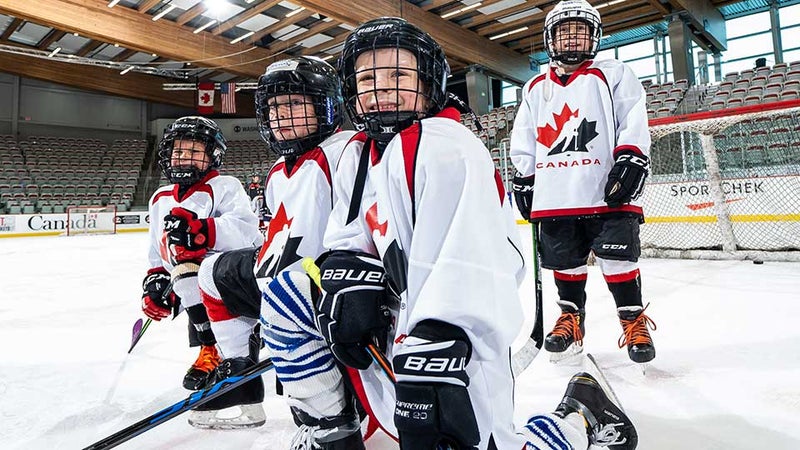
Aligning with Long-Term Player Development
Hockey Canada’s Long-Term Player Development (LTPD) framework emphasizes that athletes develop best when training environments match their age, stage of development and physical capabilities. Cross-ice hockey, half-ice hockey and small-area games are designed to support this stage-appropriate approach.
This model supports LTPD principles by providing:
- Scaled playing surfaces that align with players’ size, strength and skating ability
- When possible, use of appropriately sized nets that promote proper shooting technique and realistic scoring habits
- High levels of puck engagement that support skill acquisition and physical literacy
- Game speeds that allow athletes to read the play and develop hockey sense
- Opportunities to build fundamental movement skills and sport-specific techniques
- Safer, controlled environments that reduce risk while maintaining competition
- A progressive pathway that prepares players for full-ice hockey at later stages
By scaling the game to the athlete and not forcing young players to adapt to adult-sized environments - associations support the LTPD by focusing on strong foundations, transferable skills and long-term success.
This approach is consistent with best practices across sport. Many major organizations have adopted developmentally appropriate formats, including:
- Soccer using smaller nets and small-sided games to increase touches and decision-making
- Basketball adjusting court sizes and hoop heights to match age groups
- Baseball implementing shorter base paths and modified field dimensions
- Tennis using progressive ball and court sizes to support skill development
These models reinforce the LTPD principle that early development should prioritize learning, confidence and skill mastery before emphasizing competition and results.
International Best Practice
Many of the world’s top hockey nations competing against Canada continue to use reduced playing surfaces and small-area games during and well beyond the early stages of development.
Their programs focus on building technically strong, adaptable and confident players before emphasizing structured systems play and full-ice tactics.
International best practice highlights a common philosophy: build strong foundations first, develop skills under pressure and progress to full-ice systems as athletes mature.
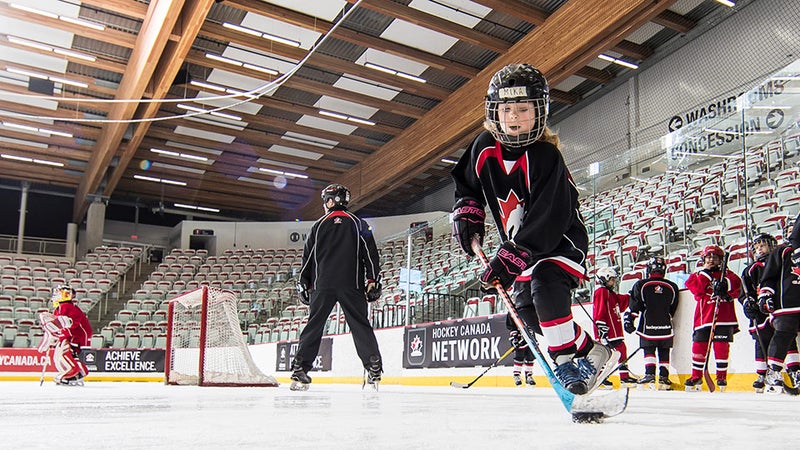
U9 hockey is where the building blocks of the game are refined and reinforced. But the program plays an important role in the special bonds that last long past the end of the game, forging friendships and making memories that are the backbone of the hockey experience.
How This Connects to Hockey Canada’s Values
This approach reflects Hockey Canada’s commitment to:
- Fun – More action, more joy
- Inclusion – Every player is involved
- Integrity – Decisions based on research and best practice
- Excellence – Building strong fundamentals first
- Ambition – Developing better players for the future
- Fair Play – Equal opportunity to learn and grow
Small-ice hockey and small-area games are not about changing the game.
They are about teaching it better.
By focusing on development, engagement and fun at young ages, we create stronger players, better teammates and a healthier hockey community for the future.