



 HOCKEY CANADA

Seasonal Structure for U9 hockey
Flexible phases can maximize development opportunities for 7 and 8 year-olds
The U9 seasonal structure can take on many forms. There is flexibility in the recommended timeframes local hockey associations can use to build their seasonal plan. If the season starts in October or even as late as November, the local hockey association should still follow the guidelines of a balanced season approach. Some dates and timeframes are guidelines, while others are fixed. The number of games and practices are also recommendations by Hockey Canada supported by the Long-Term Player Development Model.
The Ideal Season
Young players have an opportunity to continue their development while having a positive and fun hockey experience. The ideal season does not conflict with the start of the school year, provides a fair evaluation/selection process and is structured to maximize development opportunities.
The U9 Player Pathway and corresponding coaching materials provide progressive and incremental skill development. By using the Hockey Canada Skills Manuals on the Hockey Canada Network and Drill Hub, coaches are provided with the framework for practice sessions that meet their players’ needs. The monthly seasonal goals should correspond with the U9 Skills Matrix (see Section 5) that outlines the skills players should be exposed to throughout the season.
Annual Calendar and Seasonal Phases
PHASE 1: Preparation/Evaluation Phase (Up to 4 weeks)
- Players are grouped with like-ability players for maximum growth. Players should not be cut.
- Hockey Canada recommends 18 players per team.
- Allows for four lines and two goaltenders (4 on 4).
- Tiering can be done by team or by association to ensure skill-based balance.
- No evaluation/selection during the off-season phase (March through August).
- No evaluation/selection prior to the first week of school, or during the first week if it starts the week after Labour Day.
- Where school starts prior to Labour Day, there must be four skates/practices starting the week following Labour Day before evaluation/selection commences.
- Minimum of four practices/skill sessions prior to formal evaluation/selection starting.
- Minimum of three formal evaluation/selection sessions.
- Recommend one skills session, one small-area games session, one half-ice game.
PHASE 2: Development Phase (Up to 8 weeks)
- Ideal practice-to-game ratio is 3:1 – three practices to one game played.
- Focus on skill development:
- Fundamental movement skills: striding, turning, stopping
- Manipulation skills: shooting, passing, puck control
- Motor skills: agility, balance, coordination
- Fun and safe environment to promote self-confidence.
PHASE 3: Regular Season Phase (Up to 16 weeks – 14 weeks if transition)
- Ideal practice-to-game ratio is 2:1 – two practices to one game played.
- Continued focus on skill acquisition and skill development.
- Recommend a maximum of 40 games per season (exhibition, league, tournament/jamboree/festival).
- Recommended seasonal breaks:
- Season should allow for two seasonal breaks (not including Christmas/long weekends).
- Minimum five days without a scheduled game or mandatory practice.
PHASE 4: End-of-Season Phase (Up to 4 weeks – 6 weeks if transition)
- Reinforce skill-development elements in practices.
- Tournaments are jamboree/festival format, engaging players in a fun environment:
- Jamboree: Coming together of several players who are then placed onto teams. Games may or may not be competitive and the emphasis is on fun.
- Festival: Coming together of teams to participate in games and fun activities. Games may be competitive, but no standings are kept.
- There are no playoffs in U9 hockey.
- U9 players can transition to full-ice hockey December 26 or later (see game play recommendations).
- Important to continue practices through transition to introduce full-ice concepts.
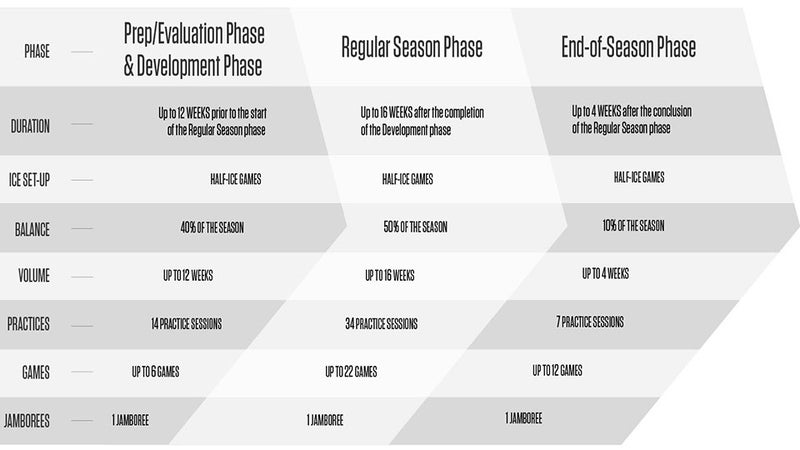
U9 Seasonal Structure OPTION 1: FULL SEASON OF HALF-ICE PLAY
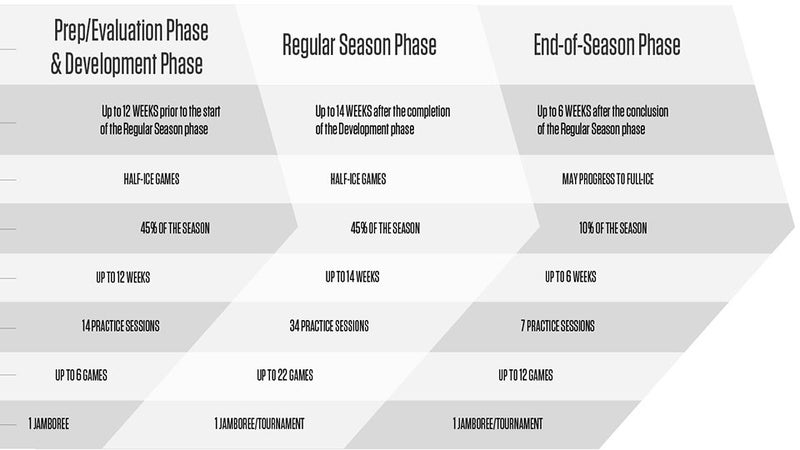
U9 Seasonal Structure OPTION 2: TRANSITION TO FULL-ICE PLAY
Game Play Guidelines
Playing Surface – Half-ice
- The maximum size of the ice surface is 100 feet by 85 feet.
- For single-year age divisions:
- Seven-year-old games will be played on half-ice all year.
- Eight-year-old games will be played half-ice from October through December and may transition to full ice December 26 or later.
- Use September as a development month – no games, just practices.
- Play a limited half-ice game schedule from October to December.
- Use January as a development month, helping transition kids to full ice.
- Play a full-ice game schedule beginning December 26 or later.
- Development of a full curriculum for the eight-year-old and the transition to full-ice programming at U11.
- For mixed programming, there will be three options available to choose from:
- Deliver half-ice programming for the full year to players 7-8 years old.
- Deliver half-ice programming for the full year to players 7-8 years old and provide a six-week transition program to the players that are eight years old in February and March.
- Deliver half-ice programming with transition to full ice December 26 or later with the understanding that a seven-year-old will repeat the programming as an eight-year-old.
Player Surface Set-up
The game play format used in U9 half-ice hockey is the Two-Team Game Play Model. This model is built on two teams playing one another in two halves. Each U9 team is divided into two units. Each team is required to dress two goaltenders, one for each half-ice game.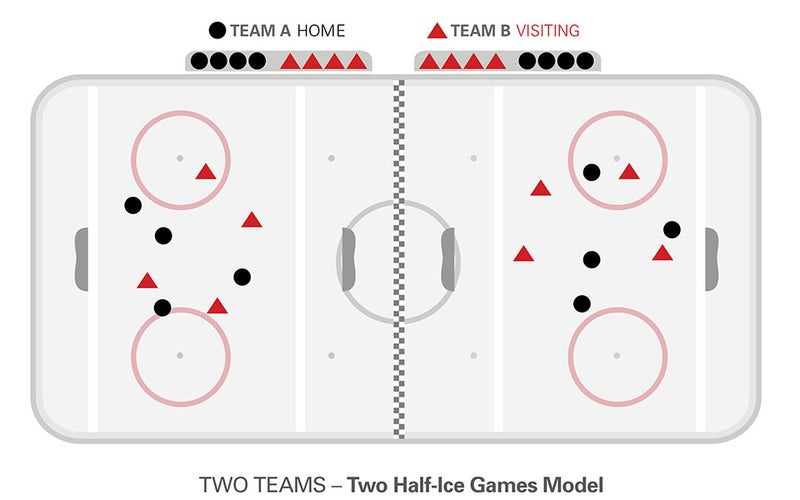
In some communities, team composition may be smaller. If this is the case, the ice is still divided but only one end will be used for game play. The other portion of the ice can be used as a practice surface.
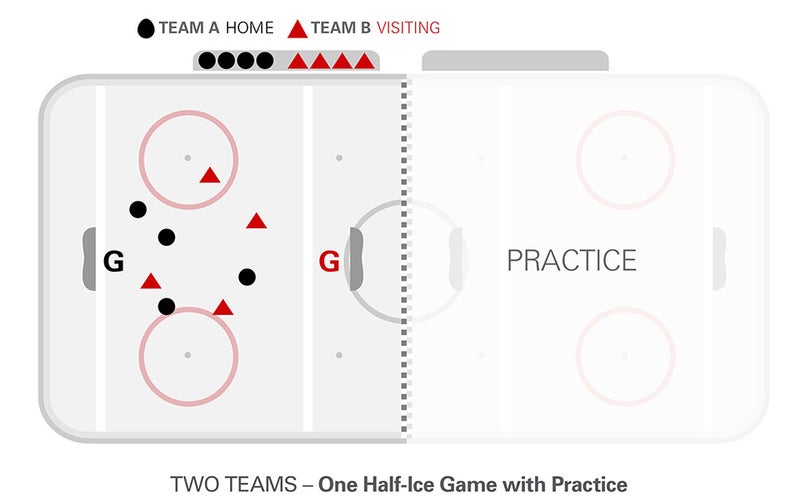
Game Set-up and Flow (Two-Team, Two-Game Model)
- Each team will be divided into two units of players, each with a goaltender. Smaller numbers allow for players to double-shift to ensure there are always four players on the ice. Coaches must make sure all players take turns double-shifting.
- Each team has two goaltenders, one for each half of the ice. This allows for two larger teams playing each other in two halves. If the two teams are balanced, one team’s unit can switch at half time to play against the other opposing unit.
- It is recommended that in each half, the centre-ice spot should be marked to indicate where the face-off will take place. This is to be established at the midpoint between both nets.
- Teams will share the player benches, with each team using the gate closest to their net.
- The score clock can be used to keep time for both games simultaneously.
- The home team shall defend the two ends of the rink, while the visiting team shall defend the centre-ice nets. After the first half, the visiting team switches ends and switches benches so players can play against the other half of the opposing team.
- No score is kept, and game sheets are optional.
Half-ice Game Play Rules
- Hockey Canada Playing Rules are followed except as stated below.
- 4-on-4 (plus a goaltender in full goalie equipment)
- Game format: two periods with a run-time clock, not to exceed 60 minutes total.
- Minimum of one official per game.
- Timed buzzer or whistle for line changes:
- Game does not stop; players change on the fly at buzzer/whistle.
- If there are fewer than four players on the bench, the active player designated to stay out for the following shift must return to the bench area prior to continuing play.
- On the buzzer/whistle, players must relinquish control of the puck immediately and vacate the ice. The new players enter the ice. Failure to relinquish control of the puck or new players entering the ice surface prematurely may result in a penalty (see below).
- Shift length will not exceed two minutes.
- Incidental contact may happen, but bodychecking is not permitted.
- No icing or offside.
- Face-offs to start each half.
- Change of possession:
- Continuous play – when whistles lead to a change in puck possession, the official will signal the attacking players to back off three metres. Once the attackers have moved back, play may resume as soon as the possession team has control of the puck.
- Goaltender freezes the puck – the official blows the whistle to indicate the attacking team backs off three metres and the defending team gets possession.
- Puck shot out of play – the offending team backs off three metres and the official gives the non-offending team a new puck.
- Blue puck (4 oz) or black puck (6 oz). (BOTH ARE ACCEPTABLE)
- Net size – 2x3, 3x4 (recommended), 4x6. (ALL ARE ACCEPTABLE)
- Penalties:
- Minor penalties are noted, with the official briefly raising their arm to indicate a penalty will be assessed. At the conclusion of the shift, the official notifies the team of the infraction and the number of the offending player.
- If the offending team controls the puck, the official blows the whistle and calls for a change of possession; the non-offending team is given a three-metre cushion.
- The offending player will sit out the next shift, but the team will play even strength.
- Should an infraction occur that would normally require a player to be ejected from the game (game misconduct, match penalty, gross misconduct), the player will be removed for the remainder of that game. Even under these circumstances, teams will not play shorthanded and no game incident report will be required.
Fair and Equal Ice Time
- All players should have the same opportunity to contribute, regardless of skill or ability. A coach’s responsibility is to develop all players. Shortening of the bench in an attempt to win games is not permitted. All players and goaltenders should receive fair and as close to equal as possible ice time.
Recommendations
- Positional rotation:
- All players play all positions – forward/defence/goaltender.
- All players get a chance to start the game or start the second half if numbers allow.
- Goaltender rotation:
- No full-time goaltenders.
- All players get a chance to play goal.